





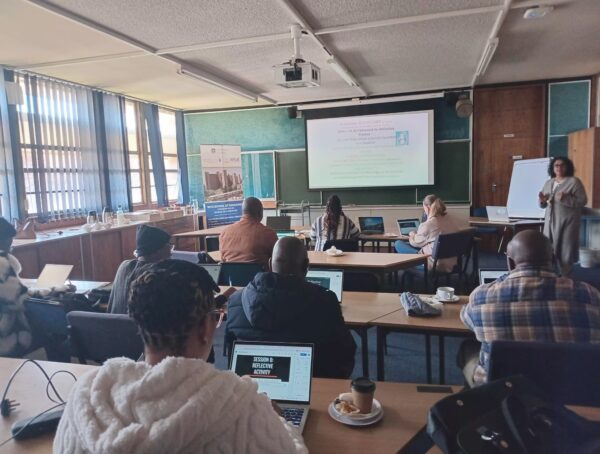
Walter Sisulu University (WSU) conducted a 2-day workshop on introducing WSU champions from different campuses to OER. The workshop was held on 20-21 July and constituted academics from different disciplines, centre for teaching and learning director, librarians and IT technicians. It was facilitated by the Acting Director of Learning and Teaching, Prof Clever Ndebele.
A key factor contributing to the success of the workshop was the integration of the institution’s Learning Management System (LMS), WiseUp, into the training. Delegates were able to access learning materials, engage with the content, collaborate with colleagues through group activities, and upload their work.
The AI tools introduced during the workshop were directly aligned with the activities and supported the achievement of the intended outcomes. Participants were expected to apply their learning by identifying an OER that they intended to use in the following semester, evaluating and adapting the resource, applying an appropriate open licence, and publishing the completed OER in OER Commons using an institutional shell created for WSU. Most participants successfully completed and published their OERs. The workshop content has been exported from the WiseUp (LMS) to the NOTES Workspace.
ADVICE FOR TEACHER EDUCATORS
- Identify the problem.
- If you do not have the competency for the activity, collaborate or identify someone with the expertise.
- At this stage, we should aim at flooding African OER. I suggest that all workshops must have a product that is published by all participants.
IMPACT BEYOND THE ACTIVITY
Interactions in such activities leads to learning from one another. As NOTES interacts in various activities, it should be easy to identify specific persons who can help. Documentation of such an activity is an important dimension of the project’s impact, as it enables the knowledge, lessons, and practices generated through the project to inform future initiatives.
KEY LESSONS
Identifying and involving key stakeholders who could work alongside the OER Champion from the outset appeared to facilitate the training process, enabling the trainers to maintain focus and effectively achieve the intended learning outcomes. Collaborative approach is essential in delivering such workshops.
KEY TAKEAWAYS
- Institutional champions are critical: Enthusiastic and committed champions can motivate colleagues and drive the institutional adoption of OER.
- Face-to-face engagement matters: In-person workshops enabled immediate interaction, collaboration, and practical support, contributing to greater productivity.
- Learning by doing is effective: Hands-on activities enabled participants to apply OER knowledge by identifying, evaluating, adapting, licensing, and publishing resources.
Tangible outputs demonstrate impact: Participants produced actual OER outputs, providing evidence of capacity development and a foundation for continued institutional engagement.
You might also like

More from Southern Africa
OER Awareness: Supporting Access, Quality and Relevance in ODeL Teacher Education
The online webinar focused on OER awareness. However, in the presentations, the webinar addressed the OER …
National Workshop on Open Learning for Schools of Education
The three-day workshop held from 24-26 March included expert presentations on open learning, institutional readiness, open …